Resources and bindings
The five bindable resource kinds, their exclusivity rules, credential references, and degradation.
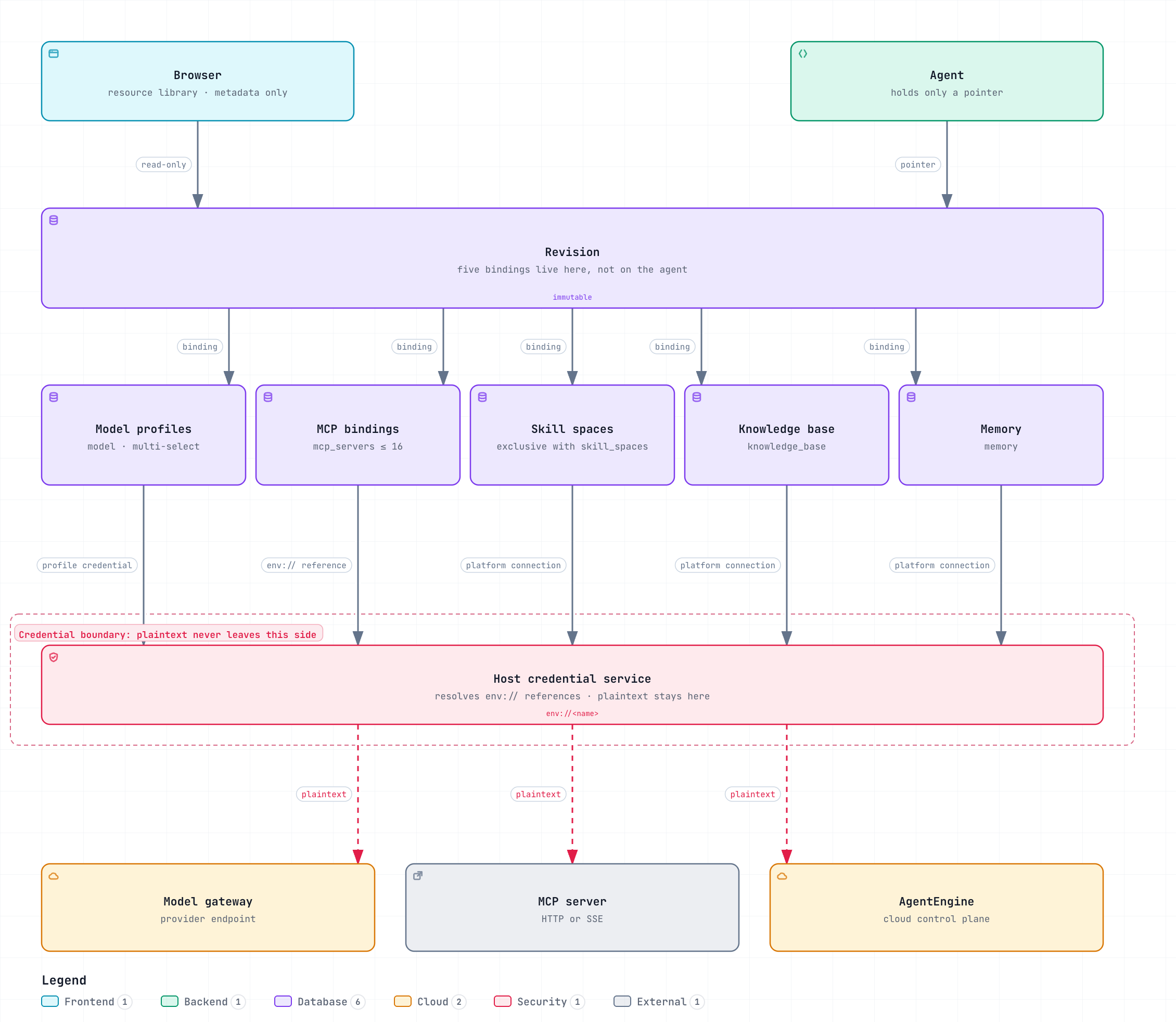
A resource binding attaches external capability to one revision. There are only five kinds: model, MCP, Skill, knowledge base, and memory. Credential values never enter a binding — they stay on the Host.
This page covers each kind's shape, which combinations are exclusive, how credentials must be written, and what the product does when a bound resource is unavailable.
 点击放大 · 滚轮缩放 · 拖拽平移
How to read this: bindings are frozen with the revision, so swapping a resource means a new revision. The credential path is one-way — the Host resolves the reference and calls the provider itself, leaving only the reference in the revision. The browser, form back-fill and transcript never see the plaintext.
Why a binding layer exists
The resource library owns only the resource catalog's lifecycle: discovery, import, probe, view, delete, and status refresh. Adding or changing which resource an agent uses must happen on the agent creation or editing page — two different actions, and conflating them leads to a wrong conclusion: that deleting a row in the library unbinds it.
Bindings live on the revision, so:
| Your action | Result |
|---|---|
| Refresh status in the resource library | Affects catalog display only; no agent changes |
| Swap an MCP server on the agent editing page | Produces a new revision; the old revision keeps its binding |
| Delete a cloud resource in the library | The cloud resource is cleaned up; existing bindings become unavailable |
The five kinds
| kind | UI label | Source | How many per agent | Binding field |
|---|---|---|---|---|
model | Model | Local model profiles plus the model gateway | Many, one of them default | Model profile |
mcp | MCP | Local MCP catalog plus the cloud catalog | Many | mcp_servers[] |
skill | Skill | Installed Skills plus cloud Skill Spaces | Many | skill_space / skill_spaces[] |
knowledge-base | Knowledge base | Cloud control plane | One | knowledge_base |
memory-instance | Memory | Cloud control plane | One | memory |
The model kind is special: it merges locally configured model profiles with the model gateway catalog. Local profiles report status as configured or credential-missing; gateway entries report available. A profile missing credentials still appears in the list, marked rather than silently hidden.
Hard rules of the managed resource contract
Managed-side resource references use agentengine.resources/v1, which accepts exactly five fields: knowledge_base, memory, skill_space, skill_spaces, mcp_servers. One extra field invalidates the whole object (MANAGED_RESOURCE_INVALID).
| Rule | Constraint |
|---|---|
| Exclusivity | skill_space and skill_spaces cannot both appear |
| List limits | skill_spaces and mcp_servers allow at most 16 entries each |
| Reference ID | Matches ^[A-Za-z0-9][A-Za-z0-9_.:-]{0,127}$ |
| Region | Matches ^[a-z0-9][a-z0-9-]{0,63}$ |
| Direct MCP endpoint | HTTP(S) only, at most 2048 characters, no embedded username/password and no query string |
| Direct MCP transport | http or sse only |
| Duplicate IDs | Not allowed within one list |
Credential references: the only correct syntax
Write credentials as env:// plus a name. Never write plaintext. Plaintext is not an unsafe habit; it is rejected:
| Location | Rule | Violation code |
|---|---|---|
| Local MCP header name | Only x-request-source, x-skill-version, x-*-client, x-*-surface, accept, content-type | MCP_HEADER_REQUIRES_REFERENCE |
| Local MCP header value | Must not contain a ${...} placeholder | MCP_HEADER_REQUIRES_REFERENCE |
| Local MCP environment variable name | Names containing TOKEN/SECRET/PASSWORD/API_KEY must use a reference | MCP_ENV_REQUIRES_REFERENCE |
| Local MCP reference value | Must match env:// plus a legal name | MCP_ENV_REF_INVALID |
Managed env_refs variable name | Matches ^MCP_[A-Z0-9_]{1,124}$ and contains one of KEY/TOKEN/SECRET/PASSWORD | MANAGED_RESOURCE_INVALID |
The managed side additionally blocks a header list: host, connection, content-length, transfer-encoding, accept, content-type, mcp-protocol-version, mcp-session-id, plus three prototype-pollution names. That list guards against request smuggling and protocol confusion, not style.
Why credentials stay on the Host
An MCP catalog record stores connection metadata and the last probe contract only; credential values belong to the DSH credential service. Writing a credential into a binding writes it into a file that ships with the build artifact.
Platform resources: three separate lists
Knowledge bases, memory instances, and Skill Spaces go through the platform resource channel and can only be selected from the cloud catalog, never typed by hand. Their binding configuration differs:
| kind | What the agent gains | Key configuration |
|---|---|---|
knowledge-base | Read-only retrieval | mode: tool, topK: 5, maxChars: 16000 |
memory-instance | Cross-session recall and write-back | Write mode defaults to explicit_only |
skill-space | Discovery and loading of cloud Skills | selectionMode: discovery, includePublic: false, executionMode: outer-agent |
Selection projects selectable metadata only (name, region, disabled flag, status). Backend credentials and internal configuration are never returned to the browser.
Degradation and strict mode
An unavailable binding is not an exception; it is an expected state. The default is to keep the conversation usable and drop only the unavailable binding:
| Item | Default behavior | Strict mode behavior |
|---|---|---|
| A binding fails its probe when starting a session | Usable immediately; that binding is removed and the rest continue | Fail closed; refuse to start |
| The prompt | Stays byte-identical; one network blip never rewrites it | Same as default |
| Background re-probe | At 30 seconds, 2 minutes, and 10 minutes after degradation | None (failure is terminal) |
| Recovery | Any strict probe that succeeds restores the full binding set | Not applicable |
The re-probe delays are offsets from the moment of degradation, not a fixed period. Three failures leave the preset degraded until the next explicit session start.
One exception: an unresolvable model route cannot start degraded. A degraded run fails immediately (RUNTIME_MODEL_UNAVAILABLE), so only a caller that explicitly opts into running with unavailable resources reaches that point. The degradation code itself is RESOURCE_UNAVAILABLE.
Resource check events
Every real resource call appends one studio/resource-check event to the session. It is content-free evidence: kind, resource ID, action, duration, and outcome — no return value, no arguments, no credentials.
| Field | Values |
|---|---|
kind | skill, skill-space, knowledge-base, memory-instance |
action | load, search, recall, write |
status | succeeded, failed |
| Optional | durationMs, hitCount, definitionCount, accepted, code |
This event is the only evidence that a resource was actually called. "Ready" in the catalog does not mean the agent invoked it successfully.
Catalog pagination rules
The resource catalog has hard limits because it merges local and cloud sources:
| Rule | Value |
|---|---|
| Page size | 1–200, default 100 |
| Source filter | all / local / cloud; anything else raises INVALID_RESOURCE_SOURCE |
| Cursor | Bound to the filter values; a changed filter invalidates the old cursor (INVALID_RESOURCE_CURSOR) |
| Deduplication | By resourceId, local wins |
| Overview | At most 200 entries per kind, then RESOURCE_OVERVIEW_TRUNCATED |
| Oversized cloud catalog | More than 1000 pages raises RESOURCE_CATALOG_TOO_LARGE |
Related tasks
Bind an MCP server
From probe to binding, including the full credential-reference syntax.
Bind a Skill
How a local Skill differs from a cloud Skill Space.
Bind knowledge bases and Memory
Retrieval and write configuration for platform resources.
Related reference
| What you need | Which page |
|---|---|
| The full fields and enumerations of the five kinds | Runtime and entity contract |
MCP_* and RESOURCE_* error codes | Errors |
| Resource-related environment variables | Environment |
| The full degradation and retry policy | Degradation and retry |