OpenAI-Compatible API
The local KsADK runtime exposes three OpenAI-compatible endpoints for development and debugging. Use the term OpenAI-compatible only for public protocol shapes. Mark SDK-specific fields as KsADK extensions.
Auth: Bearer Token
The hosted runtime requires Authorization: Bearer <token>. The local dev server does
not enforce auth by default, but the gateway injects and validates Bearer in production.
Clients should always send it so local and hosted behavior stay consistent.
Start a local server before calling these endpoints:
agentengine run . --port 8080Endpoint Summary
| Endpoint | Method | Use |
|---|---|---|
/v1/responses | POST | Responses-style local agent calls (preferred) |
/v1/chat/completions | POST | Chat Completions compatibility clients |
/v1/models | GET | List the available model catalog |
/v1/responses is the recommended local runtime protocol; /v1/chat/completions targets
existing Chat clients; /v1/models returns the current model catalog (with current /
source local extensions).
Request Lifecycle
POST /v1/responses
POST /v1/responses is the preferred local runtime protocol. It supports non-streaming
JSON, streaming SSE, checkpoint resume, and approval payloads.
Request body fields (based on the ResponsesRequest schema):
| Field | Type | Required | Notes |
|---|---|---|---|
input | string | object | array | yes | string, message object, or input item list |
model | string | no | model or agent name override; falls back to runtime default |
stream | boolean | no | true returns SSE, default false |
instructions | string | no | additional system-level instruction |
metadata | object | no | caller metadata, preserved and passed through |
conversation | string | {id} | no | conversation id or object with id (preferred over session_id) |
previous_response_id | string | no | previous response reference; mutually exclusive with conversation |
session_id | string | no | legacy local session id; prefer conversation |
user | string | no | caller/user identifier, default user |
safety_identifier | string | no | safety identifier, falls back to user_id |
prompt_cache_key | string | no | prompt cache key, written into metadata |
store | boolean | no | whether to persist, written into metadata |
model_metadata | object | no | KsADK extension: model capability hints |
model_options | object | no | KsADK extension: provider-specific options passthrough |
account_id | string | no | KsADK extension (0.6.5+): isolates Skill/Workspace/Sandbox/Memory by account |
Field exclusivity
conversation and session_id must not disagree; conversation and
previous_response_id are mutually exclusive. If both appear and target different
sessions, the runtime returns 400.
Minimal request:
{
  "model": "my-agent",
  "input": "Explain what this agent can do.",
  "stream": false
}
With conversation and account_id:
{
  "model": "my-agent",
  "conversation": {"id": "local-demo-session"},
  "input": "Continue from the previous answer.",
  "account_id": "acct_42",
  "stream": false
}
The non-streaming response returns OpenAI-compatible top-level fields plus a small number of KsADK extensions:
| Field | Status | Notes |
|---|---|---|
id | compatible | response id generated by the runtime, e.g. resp_<hex> |
object | compatible | response |
created_at | compatible | creation timestamp |
status | compatible | completed / failed / incomplete |
model | compatible | model or agent used for the request |
output | compatible | output item, usually an assistant message |
metadata | compatible | caller metadata; KsADK 0.6.9+ adds metadata.last_usage when available |
usage | compatible-shaped | per-response accumulated usage when available, used for the real cost of this response |
output_text | KsADK extension | convenient concatenated text |
session_id | KsADK extension | local session id |
{
  "id": "resp_a1b2c3",
  "object": "response",
  "created_at": 1719900000,
  "status": "completed",
  "model": "my-agent",
  "output": [
    {
      "type": "message",
      "role": "assistant",
      "content": [
        {"type": "output_text", "text": "This agent can..."}
      ]
    }
  ],
  "usage": {
    "input_tokens": 1250,
    "output_tokens": 180,
    "total_tokens": 1430,
    "input_token_details": {"cached": 900}
  },
  "metadata": {
    "last_usage": {
      "input_tokens": 980,
      "output_tokens": 180,
      "total_tokens": 1160,
      "input_token_details": {"cached": 700}
    }
  },
  "output_text": "This agent can...",
  "session_id": "local-demo-session"
}
Consumers aiming for broad compatibility should read output first and treat
output_text as a convenience field.
usage and last_usage
usage keeps the OpenAI-style accumulated usage for this response; if an
agent loop calls the model multiple times, those calls are summed. The
KsADK-specific metadata.last_usage is the final model-call usage snapshot,
used by higher layers to compute current context-window occupancy. It is not a
cumulative session total.
With stream: true the runtime returns text/event-stream, serializing streamed chunks
as Responses-style SSE events.
curl -N http://127.0.0.1:8080/v1/responses \
  -H 'Content-Type: application/json' \
  -d '{"model":"my-agent","input":"count to three","stream":true}'
Example SSE output (each data: line is one JSON object, blank line separates events):
event: response.created
data: {"type":"response.created","response":{"id":"resp_a1b2c3","status":"in_progress"}}

event: response.output_text.delta
data: {"type":"response.output_text.delta","delta":"one"}

event: response.output_text.delta
data: {"type":"response.output_text.delta","delta":"two"}

event: response.completed
data: {"type":"response.completed","response":{"id":"resp_a1b2c3","status":"completed"}}
invocation_id passthrough (0.6.5+)
Pass a custom invocation id in metadata.agentengine.invocation_id; the runtime passes
it through to the runner for transcript grouping and event resume. If omitted, the
runtime generates one automatically.
Errors use standard HTTP status codes plus a JSON detail:
| Status | Scenario | detail example |
|---|---|---|
400 | conversation conflicts with session_id | Responses field 'conversation' conflicts with ksadk legacy field 'session_id'. |
400 | conversation used with previous_response_id | Responses fields 'conversation' and 'previous_response_id' cannot be used together. |
400 | invalid conversation type | Responses field 'conversation' must be a string or an object with an 'id'. |
404 | checkpoint resume cannot find session/checkpoint | Checkpoint not found |
409 | checkpoint resume already running | {"code":"resume_already_running",...} |
500 | Runner not initialized or failed to load | Runner 未初始化 |
{
  "detail": "Responses field 'conversation' conflicts with ksadk legacy field 'session_id'. Use 'conversation' for OpenAI-compatible calls."
}
Input Items Shapes
input can be a string, a message object, or an array of input items. Multimodal examples
use OpenAI-compatible content block names:
{
  "model": "my-agent",
  "input": [
    {
      "role": "user",
      "content": [
        {"type": "input_text", "text": "Describe this image."},
        {"type": "input_image", "image_url": "data:image/png;base64,..."}
      ]
    }
  ]
}
File example:
{
  "model": "my-agent",
  "input": [
    {
      "role": "user",
      "content": [
        {"type": "input_text", "text": "Summarize this file."},
        {
          "type": "input_file",
          "filename": "notes.txt",
          "file_data": "data:text/plain;base64,..."
        }
      ]
    }
  ]
}
Remote file_url values are preserved as references. KsADK does not document a public
guarantee that the local runtime will fetch arbitrary remote files for extraction. Use
file_data or a local upload reference when you need local attachment processing.
Resume and Approval Inputs
The runtime recognizes common resume payloads in input, including function call output
and MCP approval:
{
  "type": "function_call_output",
  "call_id": "call_123",
  "output": "approved result"
}{
"type": "mcp_approval_response",
"approval_request_id": "approval_123",
"approve": true,
"reason": "Approved by local user"
}These payloads are passed to framework adapters as resume input. Application code still owns business-specific approval semantics.
- Put a resume payload (e.g.
function_call_output) into theinputof/v1/responses. - The runtime calls
extract_responses_resume_inputto identify the resume type. - For checkpoint resume, it locates by
session_id+run_id+checkpoint_id. - When found, it is converted to a runner resume input, skipping new-message normalization.
- The runner continues from the original checkpoint instead of restarting.
POST /v1/chat/completions
POST /v1/chat/completions is the compatibility protocol for Chat Completions clients. It
supports streaming and non-streaming.
Request body fields (based on the ChatCompletionRequest schema):
| Field | Type | Required | Notes |
|---|---|---|---|
messages | array | yes | chat message list |
model | string | no | model or agent name override |
stream | boolean | no | true returns SSE, default false |
user | string | no | caller/user identifier, default user |
temperature | number | no | provider option, default 0.7 |
max_tokens | integer | no | provider option |
session_id | string | no | KsADK extension: local session id |
model_metadata | object | no | KsADK extension: model capability hints |
model_options | object | no | KsADK extension: provider-specific runtime options |
account_id | string | no | KsADK extension (0.6.5+): isolates by account |
{
  "model": "my-agent",
  "messages": [
    {"role": "user", "content": "Say hello from KsADK."}
  ],
  "stream": false,
  "account_id": "acct_42"
}
Multimodal Chat-style content blocks:
{
  "model": "my-agent",
  "messages": [
    {
      "role": "user",
      "content": [
        {"type": "text", "text": "What is in this image?"},
        {"type": "image_url", "image_url": {"url": "data:image/png;base64,..."}}
      ]
    }
  ]
}
The non-streaming response returns a Chat Completions-compatible shape:
{
  "id": "chatcmpl-<uuid>",
  "object": "chat.completion",
  "created": 1719900000,
  "model": "my-agent",
  "choices": [
    {
      "index": 0,
      "message": {
        "role": "assistant",
        "content": "Hello from KsADK!"
      },
      "finish_reason": "stop"
    }
  ],
  "session_id": "<resolved-session-id>"
}
The runtime converts supported Chat Completions requests into the KsADK canonical runner input.
With stream: true the runtime returns text/event-stream using Chat Completions-style
chunks:
curl -N http://127.0.0.1:8080/v1/chat/completions \
  -H 'Content-Type: application/json' \
  -d '{
    "model": "my-agent",
    "messages": [{"role": "user", "content": "count to three"}],
    "stream": true
}'data: {"id":"chatcmpl-abc","object":"chat.completion.chunk","created":1719900000,"model":"my-agent","choices":[{"index":0,"delta":{"role":"assistant"},"finish_reason":null}]}
data: {"id":"chatcmpl-abc","object":"chat.completion.chunk","created":1719900000,"model":"my-agent","choices":[{"index":0,"delta":{"content":"one"},"finish_reason":null}]}
data: {"id":"chatcmpl-abc","object":"chat.completion.chunk","created":1719900000,"model":"my-agent","choices":[{"index":0,"delta":{"content":"two"},"finish_reason":null}]}
data: {"id":"chatcmpl-abc","object":"chat.completion.chunk","created":1719900000,"model":"my-agent","choices":[{"index":0,"delta":{},"finish_reason":"stop"}]}
data: [DONE]| Status | Scenario | Notes |
|---|---|---|
400 | messages missing or invalid | Pydantic validation failure |
500 | Runner not initialized or failed to load | Runner 未初始化 |
{
  "detail": "Runner 未初始化"
}
GET /v1/models
Lists the current available model catalog. The local runtime first fetches upstream
/v1/models from OPENAI_BASE_URL / OPENAI_API_BASE; on failure it falls back to a
single-item catalog from the local MODEL_NAME.
curl http://127.0.0.1:8080/v1/models{
"object": "list",
"data": [
{"id": "deepseek-v3.2", "object": "model", "owned_by": "kspmas"}
],
"current": "deepseek-v3.2",
"source": "MODEL_NAME"
}| Field | Notes |
|---|---|
object | list |
data | array of models, each with id, object, owned_by and other canonical metadata |
current | KsADK extension: the currently effective model id |
source | KsADK extension: source env var name (OPENAI_MODEL_NAME / MODEL_NAME / COZE_MODEL_NAME) |
Streaming Event Reference
/v1/responses streaming event names follow the OpenAI Responses style:
| Event | Meaning |
|---|---|
response.created | response object allocated |
response.in_progress | model or agent execution started |
response.output_item.added | output item started |
response.content_part.added | message content part started |
response.output_text.delta | text delta |
response.output_text.done | text content completed |
response.reasoning.delta | reasoning delta; not emitted when thinking is disabled |
response.function_call_arguments.delta | function-call arguments delta |
response.function_call_arguments.done | function-call arguments completed |
response.ksadk.tool_result | KsADK tool result extension |
response.incomplete | interrupted or waiting for approval/resume |
response.completed | final successful response |
response.failed | terminal error |
Clients should ignore unknown events they do not support, to remain forward-compatible with new runner event types.
KsADK Extension Fields
model_metadata, model_options, account_id, session_id, and output_text are
KsADK extensions and must not be described as official OpenAI fields.
account_id passthrough (0.6.5+)
account_id isolates Skill / Workspace / Sandbox / Memory by account boundary, written
into the runtime PlatformInvocationContext. Supported by both /v1/responses and
/v1/chat/completions.
invocation_id passthrough (0.6.5+)
Pass a custom invocation id in metadata.agentengine.invocation_id; the runtime passes
it through to the runner for transcript grouping and event resume. If omitted, the
runtime generates one automatically.
thinking-disable injection (0.6.7)
model_options passes provider-specific options through to supported runners. As of
0.6.7, when thinking is disabled (reasoning.effort=none, thinking.type=disabled, or
max_reasoning_tokens<=0), the runtime automatically injects enable_thinking=false
and chat_template_kwargs.enable_thinking=false into extra_body (DeepSeek
compatibility) and filters streaming reasoning output items.
- CHAT-style
reasoning.effortvalues:low/medium/high/none - Responses-style values:
none/minimal/low/medium/high/xhigh
The response.reasoning.delta event is not emitted when thinking is disabled (filtered
by the runtime).
Implementation Boundary
At runtime, protocol handlers normalize incoming requests into a common runner payload, then call the active framework runner through a narrow interface:
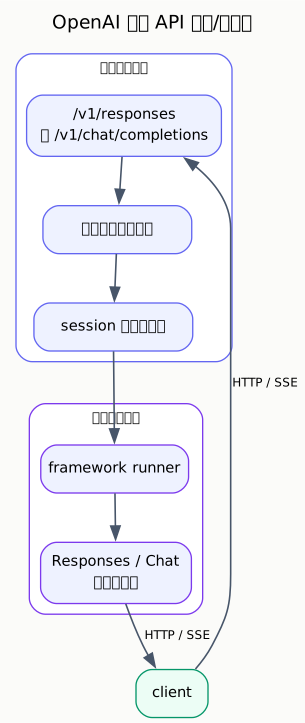
The public contract is the endpoint behavior. Internal event names, session storage details, and runner payload extensions may evolve across releases.