Runtime Sessions And Files
The local KsADK runtime provides more than request forwarding. It also manages session IDs, run events, feedback records, uploads, and workspace file previews for the local Web UI.
Runtime Surfaces
| Surface | Audience | Examples |
|---|---|---|
| OpenAI-compatible API | external clients | /v1/responses, /v1/chat/completions |
| Local Web UI API | bundled browser UI | /agentengine/api/v1/RunAgent, session and file actions |
| ADK Web compatibility | legacy local UI flows | /run_sse, /list-apps |
Public clients should prefer the OpenAI-compatible API unless they are integrating directly with the KsADK local UI.
Request Lifecycle
For local Responses calls, the runtime follows a stable sequence:
- normalize the input into messages, content blocks, and attachments.
- create or load the session.
- append the user message and
run_status=in_progress. - build
PlatformInvocationContext. - call the framework runner.
- append assistant, tool, reasoning, approval, or error events.
- append a terminal
run_status.
The same conversation runtime is shared by /v1/responses,
/v1/chat/completions, and the local Web UI run action. Protocol endpoints
mainly decide input and output shape; they do not define separate business
execution models.
Sessions
Responses calls can use conversation:
{
  "model": "my-agent",
  "conversation": {"id": "local-session-1"},
  "input": "Continue this conversation",
  "stream": false
}
Older local clients may use session_id:
{
  "model": "my-agent",
  "session_id": "local-session-1",
  "input": "Continue this conversation",
  "stream": false
}
Use one style consistently. If both are present and disagree, the local runtime rejects the request.
When PostgreSQL is configured, it is a durable session replica rather than an
availability prerequisite for agent execution. If a connection or write fails,
the runtime continues with its in-process live session and emits a structured
error when it enters session_backend_state=degraded. The runtime periodically
probes PostgreSQL; after recovery, new sessions and subsequent events are written
to PostgreSQL again and session_backend_state=recovered is logged. Older events
missed during the outage are not backfilled automatically and are not guaranteed
to survive a pod restart or relocation. While PostgreSQL is unavailable, only
history already loaded by the current process is available. A request routed to
another pod may have reduced context, but the current agent request still runs.
Readable PostgreSQL View
KsADK creates ksadk_session_events_readable alongside the raw PostgreSQL
tables. The raw content_json and metadata_json values remain available, while
the view exposes flattened message_role, message_text, tool_name,
lifecycle_status, and created_at columns for operators:
SELECT
  session_id,
  seq_id,
  message_role,
  event_type,
  message_text,
  tool_name,
  lifecycle_status,
  created_at
FROM ksadk_session_events_readable
WHERE namespace = 'default' AND session_id = '<session-id>'
ORDER BY seq_id;
Reasoning deltas are still streamed to clients in real time, but they are
persisted as one aggregated reasoning event per turn. Lifecycle events remain
separate and can be inspected through lifecycle_status.
Account Boundary
Hosted deployments pass account_id through the request chain. It is injected by
the gateway, not manufactured by the business agent. Sessions, attachments, and
workspace files are isolated per account_id; the local runtime isolates per
owner and never shares session, attachment, or workspace state across
account_id boundaries.
Web UI Sessions
agentengine web sets local UI state under the project directory unless another
session backend is configured:
.agentengine/ui/sessions.sqliteThat file is local runtime state, not source. Delete it to reset local browser sessions.
Run Events
The session store records run facts as events. Typical event types include:
| Event type | Meaning |
|---|---|
user_message | normalized user input was accepted |
run_status | lifecycle marker such as in_progress, completed, failed, or interrupted |
assistant_message | final assistant output for the turn |
tool_call | tool call emitted by the runner |
tool_result | result returned from a tool |
reasoning | provider or runner reasoning signal when available |
approval_request | run paused for user approval |
Clients should treat terminal run_status events as the end of a turn. Text
output alone does not prove the run is complete.
Session And Event Pagination
Added in 0.6.7
The hosted UI list actions expose explicit pagination fields.
ListSessions
Request fields:
| Field | Default | Constraint | Meaning |
|---|---|---|---|
AgentId | — | required | target agent id |
UserId | user | optional | user-scoped isolation |
Page | 1 | >=1 | page number, 1-based |
PageSize | 20 | 1..200 | page size, capped at 200 |
Response Data fields:
| Field | Meaning |
|---|---|
Sessions | session list on the current page |
Total | total number of matching sessions |
Page | current page number |
PageSize | current page size |
curl -sS -X POST https://<public-endpoint>/agentengine/api/v1/ListSessions \
  -H "Authorization: Bearer <api_key>" \
  -H "Content-Type: application/json" \
  -d '{"AgentId":"my-agent","UserId":"user","Page":1,"PageSize":20}'
ListSessionEvents
Request fields:
| Field | Default | Constraint | Meaning |
|---|---|---|---|
SessionId | — | required | target session id |
Offset | 0 | >=0 | event offset |
Limit | unset | >=1 | max number of events returned; when unset, all events are returned |
Response Data fields:
| Field | Meaning |
|---|---|
Events | event list on the current page |
Total | total number of events in the session |
Offset | current offset |
Limit | the limit value in effect |
curl -sS -X POST https://<public-endpoint>/agentengine/api/v1/ListSessionEvents \
  -H "Authorization: Bearer <api_key>" \
  -H "Content-Type: application/json" \
  -d '{"SessionId":"<sid>","Offset":0,"Limit":50}'
Public API clients should still prefer the OpenAI-compatible /v1/* routes unless
they integrate the hosted UI list surface directly.
Event Projection
The runtime does not send every stored event back to the model verbatim. It uses the event log as the source of truth, then projects a model-facing history from transcript events:
| Stored event | Enters model history | Projection |
|---|---|---|
user_message | yes | user message text |
assistant_message | yes | assistant/model message text |
tool_call | yes | model-side tool call summary |
tool_result | yes | user-side tool result summary |
approval_request | yes | model-side approval request summary |
approval_response | yes | user-side approval result summary |
attachment_ref | yes | user-side attachment reference |
run_status | no | lifecycle marker only |
reasoning | no | UI/debug signal only |
context_checkpoint | yes | compacted summary checkpoint |
This split is deliberate. The event log remains auditable and replayable, while
the runner sees a compact model history that excludes control events such as
run_status.
Context Compaction
Long conversations can be compacted without overwriting the event log. The runtime appends a compaction boundary and a context checkpoint that records the summary and the event sequence range it covers. Later history projection keeps the checkpoint summary and the uncompressed tail events.
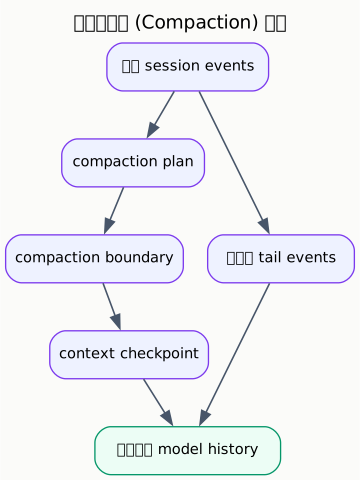
This means deleting local UI state is the right way to reset a development session, but compaction itself should not be treated as data deletion.
Session Backends
The session backend is configurable. The public local defaults are designed for development, while shared hosted deployments should use an explicitly reviewed shared backend.
| Backend | Typical use | Notes |
|---|---|---|
memory | tests and temporary runs | process-local and lost on exit |
local | local Web UI and CLI development | SQLite file under the project UI directory by default |
postgres | shared or multi-replica deployments | requires DSN and deployment review |
Useful environment variables:
| Variable | Purpose |
|---|---|
KSADK_SESSION_BACKEND | selects memory, local, or postgres |
AGENTENGINE_SESSION_BACKEND | compatibility alias for backend selection |
KSADK_SESSION_DSN | shared backend DSN, for example PostgreSQL |
KSADK_STM_PATH | local session database path |
KSADK_STM_DB_PATH | compatibility alias for local session database path |
Do not commit local session databases. They can contain prompts, extracted attachment text, local paths, tool events, and user feedback.
File And Image Inputs
The Web UI can upload files and images into the local runtime. Public protocol examples should prefer Responses-style item names:
{
  "type": "input_image",
  "image_url": "data:image/png;base64,..."
}
{
"type": "input_file",
"filename": "notes.txt",
"file_data": "data:text/plain;base64,..."
}Framework adapters receive normalized runner input. Applications should still validate file type, size, and trust boundaries before processing content.
Workspace Files
The local UI can expose workspace file operations for preview and debugging. Treat workspace content as local developer data:
- do not include customer data in public docs.
- do not publish uploaded files from local runs.
- avoid screenshots that reveal private paths, tokens, or code.
- keep generated archives out of Git unless explicitly reviewed.
Streaming, Disconnects, And Reconnects
The local Web UI run action has a reconnect-oriented design. In Responses stream mode, the server can continue consuming the runner stream after the browser disconnects, then persist the final run events to the session store. A client that reconnects should use the session id, invocation id, and last consumed sequence id to subscribe to later run events.
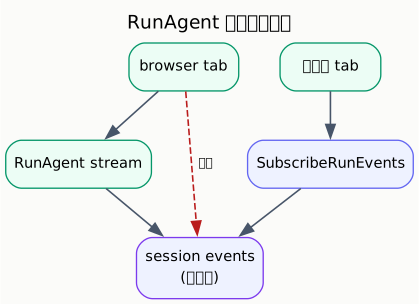
Public API clients using /v1/responses should still implement normal SSE
error handling and retry behavior. The Web UI reconnect path is a KsADK local UI
capability, not a promise that every HTTP client can resume an original TCP
connection.
Checkpoint, Resume, Cancel
Added in 0.6.7
KsADK introduces framework-level checkpoint/resume, covering list, preview,
resume, and cancel actions, with new fields such as ResumeInstruction and
CheckpointStatus. The implementation is backed by persisted run_checkpoint
/ run_resume / tool_result events and supports cross-instance recovery.
The runtime exposes five hosted UI actions for run-level checkpoint, resume,
cancel, and tool receipts. Every action is POST /agentengine/api/v1/<Action>
with a JSON body, and the response is a uniform
{ Code, Message, RequestId, Action, Data } envelope.
| Action | Path | Purpose |
|---|---|---|
ListSessionCheckpoints | POST /agentengine/api/v1/ListSessionCheckpoints | list checkpoints under a session for resume selection |
GetCheckpointResumePreview | POST /agentengine/api/v1/GetCheckpointResumePreview | preview the content and impact of resuming from a checkpoint |
ResumeRun | POST /agentengine/api/v1/ResumeRun | resume run execution from a checkpoint |
CancelRun | POST /agentengine/api/v1/CancelRun | cancel an in-progress run (keyed by InvocationId) |
ListToolReceipts | POST /agentengine/api/v1/ListToolReceipts | list tool-call receipts under a run / checkpoint |
Auth and boundaries
Local agentengine web isolates per owner by default. Hosted deployments must
send Authorization: Bearer <api_key>, and account_id is injected by the
gateway — the business agent must never forge it. Session, checkpoint, and
tool receipt state is never visible across account_id boundaries.
Checkpoint State Machine
Each checkpoint returned by ListSessionCheckpoints or
GetCheckpointResumePreview carries a CheckpointStatus, derived at read time
from is_terminal, is_resumable, resume_count, expires_at, and
replay_allowed. The runtime does not persist this field; it is computed on read:
| State | Trigger |
|---|---|
active | default; the checkpoint can still be resumed |
resumed | already resumed by ResumeRun (resume_count >= 1, not terminal) |
terminal | is_terminal=true and resume_count=0; the run reached a terminal state |
expired | expires_at has passed; IsResumable forced to false |
disabled | is_resumable=false, or replay_allowed=false after a prior resume |
CheckpointStatus is derived at read time, not persisted on the event;
resume_count and last_resumed_at come from run_resume event audit.
GetCheckpointResumePreview is only required before resume when
ResumeStatus=unknown.
Checkpoint Descriptor Fields
Each checkpoint is a projection of a run_checkpoint event. Beyond the common
event fields, it carries the following resume descriptor fields
(all added/aligned in 0.6.7):
| Field | Type | Meaning |
|---|---|---|
EventId | str | checkpoint event id |
SessionId | str | owning session id |
InvocationId | str | invocation that produced the checkpoint |
RunId | str | owning run id |
CheckpointId | str | checkpoint id (referenced when resuming) |
Framework | str | framework that produced the checkpoint, e.g. langgraph, adk |
FrameworkRef | dict | framework-specific reference, e.g. LangGraph next_node |
Phase | str | checkpoint phase label |
NextNode | str | next node to continue from after resume |
IsResumable | bool or null | whether resume is allowed; forced false when disabled |
ResumeStatus | str | resumable / disabled / unknown |
IsTerminal | bool | whether this is a terminal checkpoint |
ResumeDisabledReason | str | human-readable reason when not resumable |
Backend | str | checkpoint storage backend, e.g. memory, langgraph_store |
Scope | str | checkpoint scope, e.g. process_local |
Durable | bool | whether it is persisted (recoverable across instances) |
ArtifactPreview | dict | checkpoint artifact preview |
StageKey / StageName / StageIndex / TotalStages | various | multi-stage run information |
CreatedAt | str | checkpoint event timestamp |
LastResumedAt | str or null | timestamp of the most recent resume, from run_resume audit |
ResumeCount | int | number of resumes so far, from run_resume audit; 0 means never resumed |
ReplayAllowed | bool | policy flag for whether the same checkpoint may be resumed again; defaults to true |
ExpiresAt | str or null | checkpoint expiry; once passed, IsResumable is forced false |
CheckpointStatus | str | read-time-derived state: active / resumed / terminal / expired / disabled |
Metadata | dict | raw checkpoint event metadata, including the raw values above |
In-process checkpoints are not recoverable
When Backend == "memory" or Scope == "process_local", IsResumable is
forced false with the reason "进程内 checkpoint 不能跨实例恢复". Such
checkpoints are only valid for in-process preview during local development —
do not treat them as recoverable resume points.
ListSessionCheckpoints
List checkpoints under a session, optionally filtered by RunId or Framework,
with pagination.
| Field | Default | Constraint | Meaning |
|---|---|---|---|
AgentId | — | required | target agent id; must match the session's agent_id |
SessionId | — | required | target session id |
RunId | — | optional | only return checkpoints for this run |
Framework | — | optional | only return checkpoints for this framework, e.g. langgraph |
OnlyResumable | false | optional | only return checkpoints with IsResumable=true |
Offset | 0 | >=0 | pagination offset |
Limit | unset | 1..500 | page size, capped at 500 |
curl -sS -X POST "https://<public-endpoint>/agentengine/api/v1/ListSessionCheckpoints" \
  -H "Authorization: Bearer <api_key>" \
  -H "Content-Type: application/json" \
  -d '{
    "AgentId": "my-agent",
    "SessionId": "<sid>",
    "OnlyResumable": true,
    "Limit": 50
}'{
"Code": 0,
"Message": "Success",
"RequestId": "req-abc123",
"Action": "ListSessionCheckpoints",
"Data": {
"Checkpoints": [
{
"EventId": "evt_001",
"SessionId": "<sid>",
"InvocationId": "inv_xyz",
"RunId": "run_001",
"CheckpointId": "ckpt_002",
"Framework": "langgraph",
"IsResumable": true,
"ResumeStatus": "resumable",
"IsTerminal": false,
"ResumeDisabledReason": "",
"NextNode": "research_summarize",
"Backend": "langgraph_store",
"Scope": "session",
"Durable": true,
"LastResumedAt": null,
"ResumeCount": 0,
"ReplayAllowed": true,
"ExpiresAt": "2026-07-04T12:00:00Z",
"CheckpointStatus": "active"
}
],
"Total": 1,
"Offset": 0,
"Limit": 50
}
}| HTTP | detail.code | Trigger |
|---|---|---|
404 | — | session not found, or AgentId does not match the session's agent_id |
GetCheckpointResumePreview
Preview the impact of resuming from a checkpoint: tool receipts, side-effect risk level, and whether a preview is required before resume.
| Field | Constraint | Meaning |
|---|---|---|
AgentId | required | target agent id |
SessionId | required | target session id |
RunId | required | target run id |
CheckpointId | required | checkpoint id to preview |
curl -sS -X POST "https://<public-endpoint>/agentengine/api/v1/GetCheckpointResumePreview" \
  -H "Authorization: Bearer <api_key>" \
  -H "Content-Type: application/json" \
  -d '{
    "AgentId": "my-agent",
    "SessionId": "<sid>",
    "RunId": "run_001",
    "CheckpointId": "ckpt_002"
}'{
"Code": 0,
"Message": "Success",
"RequestId": "req_def456",
"Action": "GetCheckpointResumePreview",
"Data": {
"Preview": {
"Checkpoint": { "CheckpointId": "ckpt_002", "IsResumable": true },
"Capabilities": {
"Checkpoints": true,
"CheckpointResume": true,
"ToolReceipts": true,
"IdempotentToolReplay": true
},
"CanResume": true,
"Reason": "",
"NextNode": "research_summarize",
"ExpectedAction": "resume_from_checkpoint",
"ToolReceipts": [
{
"ReceiptId": "rcpt_001",
"ToolName": "write_workspace_file",
"ToolCallId": "call_01",
"RunId": "run_001",
"CheckpointId": "ckpt_001",
"Status": "succeeded",
"Replayed": false
}
],
"Risk": {
"Level": "medium",
"DuplicateSideEffectRisk": true,
"SideEffectReceiptCount": 1,
"FailedReceiptCount": 0
},
"Summary": {
"RunId": "run_001",
"CheckpointId": "ckpt_002",
"Phase": "after_research",
"ToolReceiptCount": 1
}
}
}
}ExpectedAction values: resume_from_checkpoint (safe to resume directly),
preview_required (ResumeStatus=unknown, a preview must be fetched first),
disabled (not resumable).
Risk.Level values:
| Level | Trigger |
|---|---|
low | no side-effect tool receipts and no failed receipts |
medium | at least one side-effect tool receipt (write_workspace_file, etc.) |
high | at least one receipt with Status=failed |
| HTTP | detail | Trigger |
|---|---|---|
404 | "Session not found" | session not found or AgentId mismatch |
404 | "Checkpoint not found" | the RunId + CheckpointId pair does not exist |
ResumeRun
Resume run execution from a checkpoint. In 0.6.7 the
ResumeInstructionEnabled / ResumeInstruction fields were added so an extra
instruction can be injected on resume, and 409 error codes distinguish
non-resumable checkpoints from duplicate resumes.
| Field | Default | Constraint | Meaning |
|---|---|---|---|
AgentId | — | required | target agent id; must match the session's agent_id |
SessionId | — | required | target session id |
RunId | — | required | run id to resume |
CheckpointId | — | required | checkpoint id to resume from |
ResumeAttemptId | — | optional | resume attempt id; defaults to resume_<hex> generated by the runtime |
InvocationId | — | optional | new invocation id; defaults to ResumeAttemptId |
Stream | false | optional | true returns an SSE stream (same shape as RunAgent stream) |
Model | — | optional | model override for this resume |
ModelMetadata | — | optional | model capability hints (0.6.7) |
ModelOptions | — | optional | provider-specific options |
ResumeInstructionEnabled | false | optional | 0.6.7; whether to inject a resume instruction |
ResumeInstruction | — | optional | 0.6.7; extra instruction text to inject on resume |
curl -sS -X POST "https://<public-endpoint>/agentengine/api/v1/ResumeRun" \
  -H "Authorization: Bearer <api_key>" \
  -H "Content-Type: application/json" \
  -d '{
    "AgentId": "my-agent",
    "SessionId": "<sid>",
    "RunId": "run_001",
    "CheckpointId": "ckpt_002",
    "ResumeInstructionEnabled": true,
    "ResumeInstruction": "redo the summary in a more concise tone",
    "Stream": false
  }'
In non-stream mode a Responses-style payload is returned:
{
  "Code": 0,
  "Message": "Success",
  "RequestId": "req_ghi789",
  "Action": "ResumeRun",
  "Data": {
    "id": "resp_<hex>",
    "object": "response",
    "model": "my-agent",
    "output": [
      { "type": "message", "role": "assistant", "content": [{ "type": "output_text", "text": "..." }] }
    ]
  }
}
Resuming a terminal checkpoint is a no-op: the runtime appends a run_resume
plus a run_status=completed event and returns status=noop without executing:
{
  "Code": 0,
  "Action": "ResumeRun",
  "Data": {
    "status": "noop",
    "Reason": "该 checkpoint 已是终态;可选择更早恢复点重跑",
    "CheckpointId": "ckpt_002",
    "RunId": "run_001",
    "ResumeAttemptId": "resume_<hex>"
  }
}
When Stream=true, the response is a text/event-stream with the same
semantics as the RunAgent stream. Each event is data: { ... }\n\n with the
event body shaped like _event_to_action_payload. After a terminal
run_status, the server sends data: [DONE].
curl -sS -N -X POST "https://<public-endpoint>/agentengine/api/v1/ResumeRun" \
  -H "Authorization: Bearer <api_key>" \
  -H "Content-Type: application/json" \
  -H "Accept: text/event-stream" \
  -d '{
    "AgentId": "my-agent",
    "SessionId": "<sid>",
    "RunId": "run_001",
    "CheckpointId": "ckpt_002",
    "Stream": true
}'| HTTP | detail.code | Trigger |
|---|---|---|
404 | — | session not found or AgentId mismatch |
404 | — | RunId + CheckpointId pair does not exist |
409 | checkpoint_not_resumable | checkpoint is not resumable (IsResumable=false), with a reason |
409 | resume_already_running | a resume is already running for this session + run |
checkpoint_not_resumable body:
{
  "detail": {
    "code": "checkpoint_not_resumable",
    "reason": "该 checkpoint 已恢复过,当前策略不允许重复恢复",
    "checkpoint_id": "ckpt_002",
    "run_id": "run_001",
    "resume_status": "disabled",
    "is_terminal": false
  }
}
resume_already_running body:
{
  "detail": {
    "code": "resume_already_running",
    "message": "A checkpoint resume is already running for this session and run.",
    "InvocationId": "inv_existing",
    "SessionId": "<sid>",
    "RunId": "run_001"
  }
}
Concurrent resume debounce
If a resume is already in progress for a given (session_id, run_id), a new
request is rejected with 409 resume_already_running. The client should wait
for the existing resume to reach a terminal state (or be cancelled) before
retrying, and never fire multiple resumes concurrently against the same run.
CancelRun
Cancel an in-progress run. As of 0.6.7, InvocationId is the primary key and
AgentId is optional (it is only used as runner cancel context and no longer
performs session ownership validation).
| Field | Default | Constraint | Meaning |
|---|---|---|---|
InvocationId | — | required | invocation id to cancel; primary key since 0.6.7 |
AgentId | — | optional | optional in 0.6.7; used as runner cancel context |
curl -sS -X POST "https://<public-endpoint>/agentengine/api/v1/CancelRun" \
  -H "Authorization: Bearer <api_key>" \
  -H "Content-Type: application/json" \
  -d '{
    "InvocationId": "inv_xyz"
}'{
"Code": 0,
"Message": "Success",
"RequestId": "req_jkl012",
"Action": "CancelRun",
"Data": {
"Cancelled": true,
"Found": true,
"Status": "cancelling",
"RunnerCancelStatus": "accepted"
}
}| Field | Meaning |
|---|---|
Cancelled | whether cancel was requested (detached stream or runner accepted) |
Found | whether a detached stream was found for the invocation |
Status | cancelling / not_found / unsupported / error |
RunnerCancelStatus | runner-side cancel result: accepted / cancelling / cancelled / not_found / unsupported / error |
CancelRun never returns 4xx. Even when the invocation does not exist it
returns { Cancelled: false, Found: false, Status: "not_found" }, which the
client can use to decide next steps.
ListToolReceipts
List tool-call receipts under a run / checkpoint, useful for assessing side-effects before resume or for after-the-fact auditing.
| Field | Default | Constraint | Meaning |
|---|---|---|---|
AgentId | — | required | target agent id; must match the session's agent_id |
SessionId | — | required | target session id |
RunId | — | optional | only return receipts for this run |
CheckpointId | — | optional | only return receipts for this checkpoint |
curl -sS -X POST "https://<public-endpoint>/agentengine/api/v1/ListToolReceipts" \
  -H "Authorization: Bearer <api_key>" \
  -H "Content-Type: application/json" \
  -d '{
    "AgentId": "my-agent",
    "SessionId": "<sid>",
    "RunId": "run_001"
}'{
"Code": 0,
"Message": "Success",
"RequestId": "req_mno345",
"Action": "ListToolReceipts",
"Data": {
"ToolReceipts": [
{
"EventId": "evt_010",
"SessionId": "<sid>",
"InvocationId": "inv_xyz",
"SeqId": 10,
"Timestamp": "2026-07-03T10:00:00Z",
"ReceiptId": "rcpt_001",
"IdempotencyKey": "idem_abc",
"ToolName": "write_workspace_file",
"ToolCallId": "call_01",
"RunId": "run_001",
"CheckpointId": "ckpt_001",
"Status": "succeeded",
"Replayed": false,
"Metadata": { "tool_name": "write_workspace_file" }
}
]
}
}| Field | Meaning |
|---|---|
ReceiptId | receipt id, keyed by idempotency |
IdempotencyKey | idempotency key, used for deduplication on replay |
ToolName | tool name; side-effect tools (write_workspace_file, etc.) flag DuplicateSideEffectRisk |
ToolCallId | the corresponding tool call id |
RunId / CheckpointId | owning run / checkpoint |
Status | succeeded / failed |
Replayed | whether this receipt was produced by a replay |
| HTTP | detail | Trigger |
|---|---|---|
404 | "Session not found" | session not found or AgentId mismatch |
ResumeMode
GetAgentUiBootstrap returns RuntimeCapabilities.ResumeRun.ResumeMode, which
describes the framework-level resume capability:
| ResumeMode | Meaning |
|---|---|
time_travel | can rewind to a historical checkpoint (LangGraph runner) |
forward_only | can only continue forward along invocation continuity, cannot rewind (ADK runner) |
none | the framework has no framework-level resume capability |
RunLifecycle Gating
The frontend resume entry point must not look at ResumeMode alone. It must
also check the two RunLifecycle flags returned by bootstrap:
RunLifecycle.Checkpoints = true: the session has usable checkpoints.RunLifecycle.CheckpointResume = true: the runtime supports resuming from a checkpoint.
If either is false, treat resume as unsupported and do not surface the
ResumeRun entry point. RunLifecycle.CheckpointResumePreview indicates
whether GetCheckpointResumePreview is available.
SubscribeRunEvents
The local UI reconnect flow is based on persisted events, not on resuming the same HTTP stream:
curl -sS -N "https://<public-endpoint>/agentengine/api/v1/SubscribeRunEvents?SessionId=<sid>&InvocationId=<iid>&AfterSeqId=42" \
  -H "Authorization: Bearer <api_key>" \
-H "Accept: text/event-stream"| Field | Meaning |
|---|---|
SessionId | target session id |
InvocationId | target invocation id |
AfterSeqId | subscription starting seq_id; the stream returns events with seq_id > AfterSeqId. Defaults to 0, which subscribes from the beginning |
5-minute server-side guard timeout
SubscribeRunEvents has a 5-minute (5 * 60 seconds) server-side guard
timeout. When the timeout elapses the server closes the SSE stream on its own.
The client must re-issue the subscription using the last consumed seq_id as
the new AfterSeqId, and keep doing so until a terminal run_status is observed.
Once a terminal run_status (completed, failed, cancelled, interrupted)
appears, the server sends data: [DONE] and ends the stream; otherwise the
client must re-subscribe with the latest seq_id after the 5-minute timeout.
Upload References
When the local UI uploads a file, the server returns a ksadk-upload://...
reference. That reference is accepted only by the local runtime that created it.
Do not store those URIs in source files or public examples as durable external
URLs.
Upload URI Scheme
Added in 0.6.7
Local and hosted uploads are unified under attachment URI schemes, resolved by a single read entry point.
Both schemes are read through the same route:
curl -sS "https://<public-endpoint>/agentengine/api/v1/AttachmentContent?FileUri=ae-upload://<file_id>" \
-H "Authorization: Bearer <api_key>"| Scheme | Source | Meaning |
|---|---|---|
ksadk-upload://{file_id} | local agentengine web upload | written by the local AttachmentStorageService, bound to the running server |
ae-upload://{file_id} | hosted-link upload | hosted-platform attachment reference that the server resolves on read |
When resolving an ae-upload:// URI, the server locates the hosted upload content
by the {file_id} and returns its byte stream, while also writing the content
back to a local cache (local_path) so that subsequent reads hit the cache.
Paths without the ae-upload:// prefix are treated as workspace-relative paths.
AttachmentContent returns an attachment represented internally as
AttachmentBytes:
| Field | Type | Meaning |
|---|---|---|
data | bytes | raw attachment bytes |
display_name | str | sanitized display filename |
mime_type | str | MIME type; inferred from the filename when missing |
local_path | Path or None | absolute local cache path; populated after a hosted attachment is first read and cached |
Feedback
The local runtime includes feedback endpoints for UI interactions. Feedback records are useful for debugging and evaluation flows, but public examples should use fake response IDs and comments.
Cancellation And Reconnects
Streaming runs may continue after a browser refresh or SSE disconnect. Clients that implement streaming should support:
- cancellation.
- reconnecting to known invocation/session state.
- displaying partial output safely.
- handling final error events.
Security Boundary
The local runtime is for development. Do not expose it directly to the public internet without authentication, request limits, file validation, and review of the hosted runtime boundary.