Concepts
KsADK has four public building blocks: a project template, a framework adapter, a local runtime, and a local debugging UI.
Understand these four blocks and you can decide whether an issue belongs in agent code, project config, the Runner, the protocol layer, or the Web UI.
KsADK And The Agent Lifecycle
KsADK focuses on the local development loop for agent projects: create or import an agent, configure a model provider, run it locally, inspect the execution path, then package reviewed artifacts when a deployment path is approved.

The public SDK intentionally keeps this loop local-first. Hosted AgentEngine deployment and cloud packaging are optional capabilities, not prerequisites for learning the open-source runtime.
Project
A KsADK project is a normal Python project with an agent entry point and optional configuration files. The default convention:
agent.pyor a package-level agent module exportsroot_agent.agentengine.yaml,ksadk.yaml, orksadk.ymldescribes the framework and entry point..envstores local credentials and model settings.
The detector can also infer a project from common files such as agent.py,
main.py, app.py, package directories, and langgraph.json.
Framework Adapter
KsADK does not replace framework APIs. It wraps common framework outputs so they can be invoked through a consistent runtime with one set of local commands, one Web UI, and one OpenAI-compatible protocol.
| Framework | Typical exported object |
|---|---|
| Google ADK | root_agent = Agent(...) |
| LangGraph | root_agent = graph.compile() |
| LangChain | runnable chain or agent assigned to root_agent |
| DeepAgents | root_agent = create_deep_agent(...) |
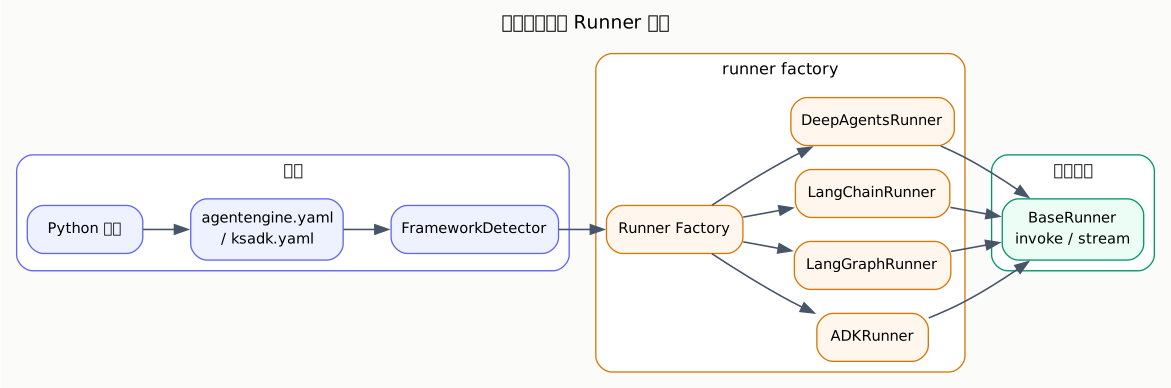
The runner contract is the key public abstraction: framework-specific details
stay inside adapters, while the server and conversation runtime only depend on
invoke, stream, model overrides, sessions, and context.
Local Runtime
agentengine run loads the project, detects the framework, and starts a local
runtime. In interactive mode it runs directly in the terminal. In server mode it
exposes HTTP endpoints that the Web UI and API clients can call.
The local runtime is the safest default for public examples because it does not require private Kingsoft Cloud infrastructure.
Local Web UI
agentengine web starts the browser debugging experience for local projects.
Users install the Python package and do not need Node.js for the bundled UI.
Repository boundaries
The Python SDK repository kingsoftcloud/ksadk-python and the Web UI repository
kingsoftcloud/ksadk-web are separate. The Python package embeds generated
static assets; future UI source changes should be made in ksadk-web, then
consumed by the Python SDK and hosted UI.
Public Versus Hosted Capabilities
Some CLI commands support cloud packaging or hosted AgentEngine operations. Those commands may require Kingsoft Cloud credentials and should be treated as optional in public documentation.
Local-first docs should prefer:
- OpenAI-compatible provider settings.
- fake or user-owned API keys.
- local files, SQLite, or in-memory stores.
--dry-runwhen explaining deployment-shaped commands.
Public examples must not require internal kubeconfig files, private registries, private gateways, private object storage, or customer data.
Documentation Layers
Use the docs layers consistently:
| Layer | Purpose |
|---|---|
| Getting Started | explain concepts and first local run |
| Tutorials | provide complete runnable files |
| Guides | explain task workflows and tradeoffs |
| Reference | define command, config, and API contracts |
| Contributing | explain release and governance gates |
This keeps public docs maintainable. A tutorial can say "copy this file"; a reference page should say what fields mean and which values are accepted.
Repository Boundaries
The Python repository owns Python SDK behavior. The planned ksadk-web repository
owns editable UI behavior. The Python package should consume a reviewed UI build
artifact or pinned source ref, not carry a divergent editable UI implementation
forever.