Memory And Knowledge
KsADK includes memory and knowledge integration points for agent applications. The public documentation treats these as optional capabilities layered on top of the local runtime.
Capability Model
Memory and knowledge are related, but they solve different problems:
| Capability | Purpose | Typical scope | Public-docs rule |
|---|---|---|---|
| Session history | Keep the current conversation coherent | one local session | enabled by the runtime |
| Long-term memory | Store user facts, preferences, or prior decisions across sessions | user and application | optional; use fake data in docs |
| Knowledge base | Retrieve external documents relevant to the current request | dataset or corpus | optional; avoid private datasets |
| Framework tools | Let the agent explicitly call memory or search tools | agent implementation | document the hook surface |
| Ambient context | Add retrieved memory or knowledge text before the runner call | runtime payload | mark as KsADK runtime behavior |
Session history is always part of the local conversation runtime. Long-term memory and knowledge base retrieval are opt-in integrations. Public quickstarts should run without any hosted memory or private knowledge service.
Runtime Boundary
KsADK separates memory and knowledge into three layers:
- framework tools, where the agent explicitly calls
load_memory,save_memory, or a knowledge search tool. - ambient context, where the runtime retrieves short formatted context before calling the runner.
- backend services, where application-specific storage or retrieval happens.
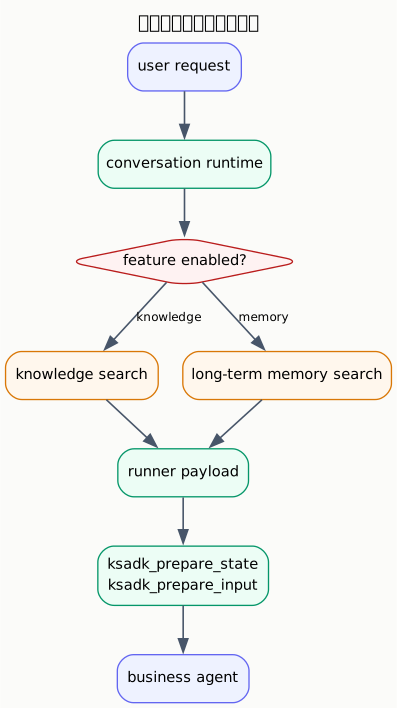
The public contract is the payload and hook shape. A concrete hosted memory or knowledge backend is an optional deployment choice.
What To Use Locally
For open-source examples, prefer storage that a developer can run without a private account:
- in-memory state for quick tests.
- local files for deterministic examples.
- SQLite for small persistent demos.
- a local Redis instance only when the guide explicitly needs Redis behavior.
Use hosted memory or hosted knowledge base examples only after the credential model and dataset boundary are public. Until then, document those features as optional extension points.
Long-Term Memory
Long-term memory is accessed through a small backend contract:
| Operation | Meaning |
|---|---|
save_memory(user_id, event_strings, **kwargs) | persist one or more user-scoped facts or events |
search_memory(user_id, query, top_k, **kwargs) | retrieve relevant memories for a query |
The runtime service chooses a backend from environment configuration, formats results into prompt text, and exposes framework tools such as load_memory and save_memory. If no long-term memory backend is configured, the public runtime should continue to work normally.
Backend options can include local test stores, HTTP services, or cloud SDK integrations. For open-source examples, document the interface first and make hosted backends optional.
Example local shape:
def save_preference(memory_store: dict[str, list[str]], user_id: str, value: str) -> None:
    memory_store.setdefault(user_id, []).append(value)


def search_preferences(memory_store: dict[str, list[str]], user_id: str, query: str) -> list[str]:
    return [item for item in memory_store.get(user_id, []) if query.lower() in item.lower()]
This intentionally uses an in-process dictionary. It is enough for a tutorial, but production applications should choose a durable backend and define retention and privacy policies.
Knowledge Retrieval
Knowledge retrieval is for external facts, manuals, or product data. The public SDK should not assume a private hosted dataset. A public example can use a small local file corpus:
DOCUMENTS = [
    {"title": "refund-policy.md", "text": "Refunds are reviewed within 5 business days."},
    {"title": "shipping.md", "text": "Standard shipping takes 3 to 7 business days."},
]


def search_documents(query: str, top_k: int = 3) -> list[dict[str, str]]:
    query_lower = query.lower()
    matches = [doc for doc in DOCUMENTS if query_lower in doc["text"].lower()]
    return matches[:top_k]
Hosted knowledge integrations can follow the same visible shape: a query enters the retriever, the retriever returns scored snippets, and the runner receives a short formatted context block. Keep raw private document IDs, account IDs, and dataset names out of public examples.
ADK Versus Other Frameworks
ADK projects can receive memory and knowledge through ADK-compatible tools and, when configured, an ADK memory service. LangGraph, LangChain, and DeepAgents projects should usually receive context through the runner payload or explicit hook functions.
| Framework path | Recommended public pattern |
|---|---|
| ADK | expose optional ADK tools; keep the minimal sample credential-free |
| LangGraph | map kb_context and memory_context inside ksadk_prepare_state |
| LangChain | compose context into the chain input with ksadk_prepare_input |
| DeepAgents | pass context through model/tool configuration used by the app |
This distinction matters because ADK has native tool and memory concepts, while message/state frameworks often need application-specific state mapping.
Runtime Context Flow
When configured, KsADK can build memory and knowledge context before calling the framework runner:
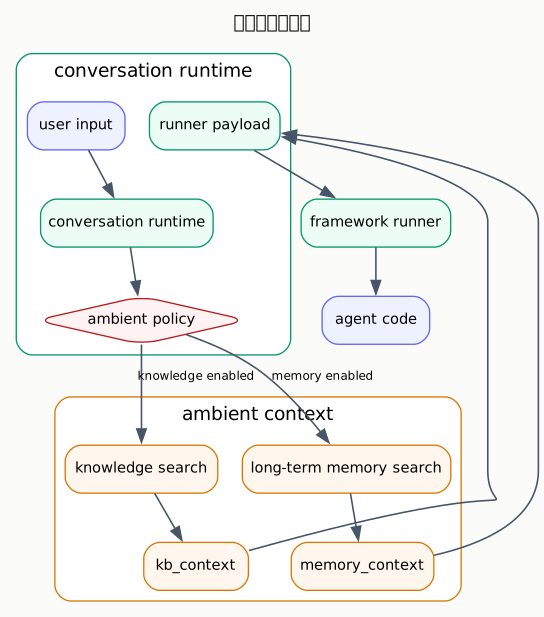
kb_context and memory_context are KsADK runtime extensions. They should be described as local runner context, not as official OpenAI protocol fields.
Framework Integration
Memory and knowledge features should be exposed through normal framework hooks:
- ADK tools or callbacks.
- LangChain tools.
- LangGraph state and checkpointers.
- DeepAgents model/tool configuration.
The exact implementation should be selected by the application. KsADK should provide runtime compatibility and examples, not force one hosted backend in the public quickstart.
LangGraph
For LangGraph projects with custom state, expose a top-level ksadk_prepare_state(payload, session_context) function. Use the payload for the current input and the session context for runtime-provided context:
def ksadk_prepare_state(payload: dict, session_context: dict) -> dict:
    return {
        "messages": payload.get("input_messages", []),
        "question": payload.get("input", ""),
        "knowledge": session_context.get("kb_context"),
        "memory": session_context.get("memory_context"),
    }
For messages-native graphs, the default runner can often build the state without a custom hook. Add a hook when your graph uses fields beyond messages.
LangChain
For LangChain projects, expose ksadk_prepare_input(payload, session_context) when the application needs direct access to memory or knowledge context:
def ksadk_prepare_input(payload: dict, session_context: dict) -> str:
    sections = []
    if session_context.get("kb_context"):
        sections.append("Knowledge context:\n" + session_context["kb_context"]["formatted_text"])
    if session_context.get("memory_context"):
        sections.append("Memory context:\n" + session_context["memory_context"]["formatted_text"])
    sections.append("User request:\n" + payload.get("input", ""))
    return "\n\n".join(sections)
ADK
ADK projects should prefer ADK-native tools and services. KsADK can expose memory and knowledge tools in ADK-compatible form when those optional integrations are configured. Public samples should still run with local or fake data unless hosted credentials are intentionally part of the sample.
Environment Variables
Use placeholders in public docs. The exact backend configuration may vary by deployment, but these names define the public-facing configuration family:
| Variable | Purpose |
|---|---|
KSADK_LTM_BACKEND | enable a long-term memory backend |
KSADK_LTM_INDEX | isolate an application or collection |
KSADK_LTM_TOP_K | default number of memories to retrieve |
KSADK_KB_DATASET_ID | enable a knowledge dataset integration |
KSADK_KB_TOP_K | default number of document snippets to retrieve |
KSADK_KB_SEARCH_METHOD | retrieval method when supported by the backend |
KSADK_KB_SCORE_THRESHOLD | optional relevance threshold |
Do not commit real values for dataset IDs, tokens, access keys, or customer collection names. Put private values in local .env files or CI secrets.
OpenClaw Memory Backend (Optional)
New in 0.6.7
The OpenClaw runtime can declare a memory backend through a manifest. An in-process LanceDB memory plugin has been added.
The OpenClaw runtime declares a memory backend through MEMORY_BACKEND_MANIFEST. The backend_type can be one of:
backend_type | Description | When to use |
|---|---|---|
openclaw_default | built-in OpenClaw memory | when no external memory service is needed |
mem0 | connect to an external mem0 service | when you already run mem0 and need shared memory across sessions/instances |
lancedb | in-process LanceDB memory plugin | local persistent memory with no external dependencies |
Notes:
lancedbmaps to an in-process LanceDB memory plugin (plugin idmemory-lancedb) and is not exposed through theagentengine openclaw deploy --memory-systemCLI; that CLI choice is limited toopenclaw_default/mem0.- When
mem0is selected,MEM0_API_KEY/MEM0_USER_ID/MEM0_BASE_URLare required (injected by the hosted platform). - Rendering the
memory-lancedboutput disablesopenclaw-mem0to avoid loading both backends at once. - The manifest
configcan optionally overridedbPath,embedding, andstorageOptions.
backend_type: lancedb
config:
  dbPath: /data/agent-memory/lance
  embedding:
    provider: openai
    model: text-embedding-3-small
  storageOptions:
    topK: 5
Public surface
The manifest and secrets above are injected by the hosted platform. Public docs do not expose internal endpoints, accounts, or tokens; examples use placeholders such as example.com / sk-test / cm-appkey-placeholder.
For the full variable list, see ksadk environment variables reference.
Failure Behavior
Memory and knowledge integrations should be best-effort in local development:
- missing optional configuration should not stop a normal quickstart.
- retrieval errors should be surfaced as diagnostics, not hidden as successful empty context.
- agent code should handle
None, empty context, and partial results. - tests should cover behavior with integrations disabled.
Hosted Integrations
Hosted memory, knowledge base, and Skill Service integrations can be documented as optional capabilities after their public credential model is approved.
Public docs must not require:
- internal service tokens.
- customer datasets.
- private traces or logs.
- internal object storage.
- private support URLs.
Recommended Public Example Pattern
When adding a memory or knowledge example to the public repository:
- make the first run work with no hosted credentials.
- use a tiny local corpus or in-memory store.
- show where to swap in a real backend.
- keep user data, extracted document text, and traces out of the repository.
- document whether the example uses session history, long-term memory, or knowledge retrieval.
Example Data Rule
Examples should use fake data or public sample data. Treat logs, traces, memory snapshots, uploaded files, and knowledge base records as potentially sensitive until reviewed.