Runtime Products: Hermes And OpenClaw
KsADK supports two image-based runtime products in addition to code-framework agents:
- Hermes: a hosted coding-agent runtime with dashboard, API proxy, terminal WebSocket, and workspace files.
- OpenClaw: a hosted OpenClaw gateway runtime where KsADK adds deployment, workspace files, memory backend wiring, and CLI lifecycle management.
These are runtime products, not ordinary local framework projects. A LangGraph or ADK project packages user code. Hermes and OpenClaw deploy a maintained runtime image plus public configuration.
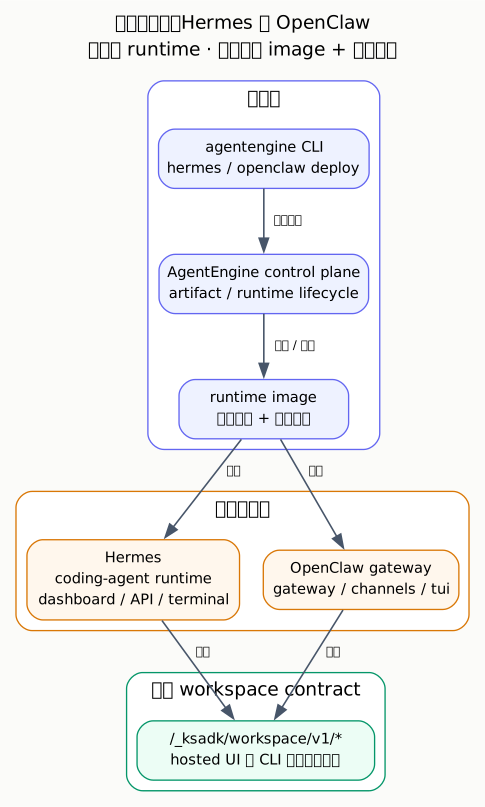
When To Use Which Runtime
| Need | Recommended path |
|---|---|
| Python agent code with LangGraph, ADK, LangChain, or DeepAgents | normal code framework project |
| Hosted coding assistant with terminal and workspace | Hermes |
| OpenClaw gateway, channels, or OpenClaw-native UI | OpenClaw |
| Public quickstart that must run without cloud credentials | normal local framework project |
Do not present Hermes or OpenClaw as just another StateGraph or Agent
wrapper. They have separate lifecycle commands and deployment contracts.
Lifecycle Comparison
Typical flow and command shape for each runtime. Same concept, two runtimes — use the tabs below:
Typical flow:
- Configure model placeholders in local
.envor shell. - Review the dry run where supported.
- Deploy the Hermes runtime.
- Open the dashboard or connect the terminal.
- Use workspace files for generated artifacts.
Public examples should use placeholder model values:
OPENAI_BASE_URL=https://api.example.com/v1
OPENAI_MODEL_NAME=my-model
Hermes terminal access uses a WebSocket subprotocol:
Sec-WebSocket-Protocol: ks-terminal.v1The CLI handles the subprotocol for normal users. API clients should treat it as part of the remote runtime contract.
Typical flow:
- Create or enter an OpenClaw project.
- Configure model placeholders and optional runtime policy.
- Deploy through
agentengine openclaw deploy. - Use
status,tui,gateway open, or channel commands for operations. - Keep workspace artifacts inside the runtime workspace.
For public examples, document policy knobs without internal values:
agentengine openclaw deploy \
  --model-base-url https://api.example.com/v1 \
  --model-api-key sk-test \
  --default-model my-model
Workspace And Files
Hermes and OpenClaw both expose KsADK workspace files through the
/_ksadk/workspace/v1/* family. Generated files should stay inside the runtime
workspace so the hosted UI and CLI file commands see the same artifacts.
Do not document arbitrary host-path access in public docs.
The public model is:
- list workspace files.
- read or download a workspace file.
- add or update a workspace file.
- delete a workspace file when permitted.
- export a workspace archive when the hosted surface supports it.
Model Configuration Boundary
New in 0.6.7
Hermes and OpenClaw deploy inject a unified model policy env that the runtime uses to pick primary, multimodal, and fallback models.
The unified policy is carried by AGENTENGINE_MODEL_POLICY_JSON, while each
runtime also exposes its own DEFAULT/FALLBACK/IMAGE/CATALOG variables for
fine-grained override:
| Variable | Description |
|---|---|
AGENTENGINE_MODEL_POLICY_JSON | unified model policy: primary/multimodal/fallback and optional catalog |
HERMES_DEFAULT_MODEL | Hermes default (primary) model override |
HERMES_FALLBACK_MODEL | Hermes fallback model override |
HERMES_MODEL_CATALOG_JSON | Hermes optional model catalog override |
OPENCLAW_DEFAULT_MODEL | OpenClaw default (primary) model override |
OPENCLAW_FALLBACK_MODEL | OpenClaw fallback model override |
OPENCLAW_IMAGE_MODEL | OpenClaw image-scenario model override |
OPENCLAW_MODEL_CATALOG_JSON | OpenClaw optional model catalog override |
The default policy is:
- primary =
glm-5.2 - multimodal =
kimi-k2.7-code - fallback =
deepseek-v4-pro
AGENTENGINE_MODEL_POLICY_JSON='{"primary":"glm-5.2","multimodal":"kimi-k2.7-code","fallback":"deepseek-v4-pro"}'Override precedence
Explicit env wins. Setting HERMES_DEFAULT_MODEL / OPENCLAW_DEFAULT_MODEL
and friends overrides the matching field of the unified policy for that
runtime; when unset, the runtime falls back to the default value in
AGENTENGINE_MODEL_POLICY_JSON.
OpenClaw image scenario default
The OpenClaw image scenario defaults to kimi-k2.7-code (the multimodal
field of the unified policy). To pin a different model, set
OPENCLAW_IMAGE_MODEL to override.
Public examples show only the placeholder shape, never real endpoints or tokens.
OPENAI_BASE_URL=https://api.example.com/v1Memory And Tooling Boundaries
Hermes and OpenClaw may read model, memory, channel, or tool configuration from environment variables. Public docs should keep these variables as names and placeholders, not real values.
| Category | Public-safe examples |
|---|---|
| model | OPENAI_API_KEY, OPENAI_BASE_URL, OPENAI_MODEL_NAME |
| memory | KSADK_LTM_BACKEND, KSADK_LTM_NAMESPACE, KSADK_LTM_SCENE_ID |
| workspace | KSADK_WORKSPACE_FILES_ENABLED, runtime workspace path labels |
| OpenClaw policy | strict mode, workspace-only filesystem policy, approval mode |
| secrets | variable names only; never commit literal tokens |
Memory backend wiring
New in 0.6.7
KSADK_LTM_BACKEND selects the memory backend. The three options differ in
storage and retrieval capabilities.
| backend_type | Description |
|---|---|
openclaw_default | OpenClaw default memory backend, integrated into the OpenClaw gateway lifecycle |
mem0 | Mem0 memory backend; requires additional KSADK_LTM_NAMESPACE and scene config |
lancedb | Local LanceDB memory backend, suited to fast validation without external dependencies |
KSADK_LTM_BACKEND=openclaw_default
KSADK_LTM_NAMESPACE=my-agent
KSADK_LTM_SCENE_ID=default
Backend switching
Different backends have different persistence and retrieval semantics. After
switching KSADK_LTM_BACKEND, existing memories are not migrated
automatically; to preserve history, export from the old backend first and
import into the new one.
What Stays Internal
Do not publish:
- private runtime image names or registries.
- private-environment endpoints.
- kubeconfig files or cluster names.
- real channel tokens, model keys, or kdocs tokens.
- customer workspace paths or object storage buckets.
- incident runbooks tied to internal platforms.
The public docs should explain the contract and lifecycle. Operational details for a specific private environment belong in internal documentation.