Hosting a Custom UI Agent
This tutorial explains one thing clearly: how a business-owned frontend bundle runs on a hosted runtime — local debugging and cloud deployment share the same bootstrap contract, so the frontend never branches on "am I local?".
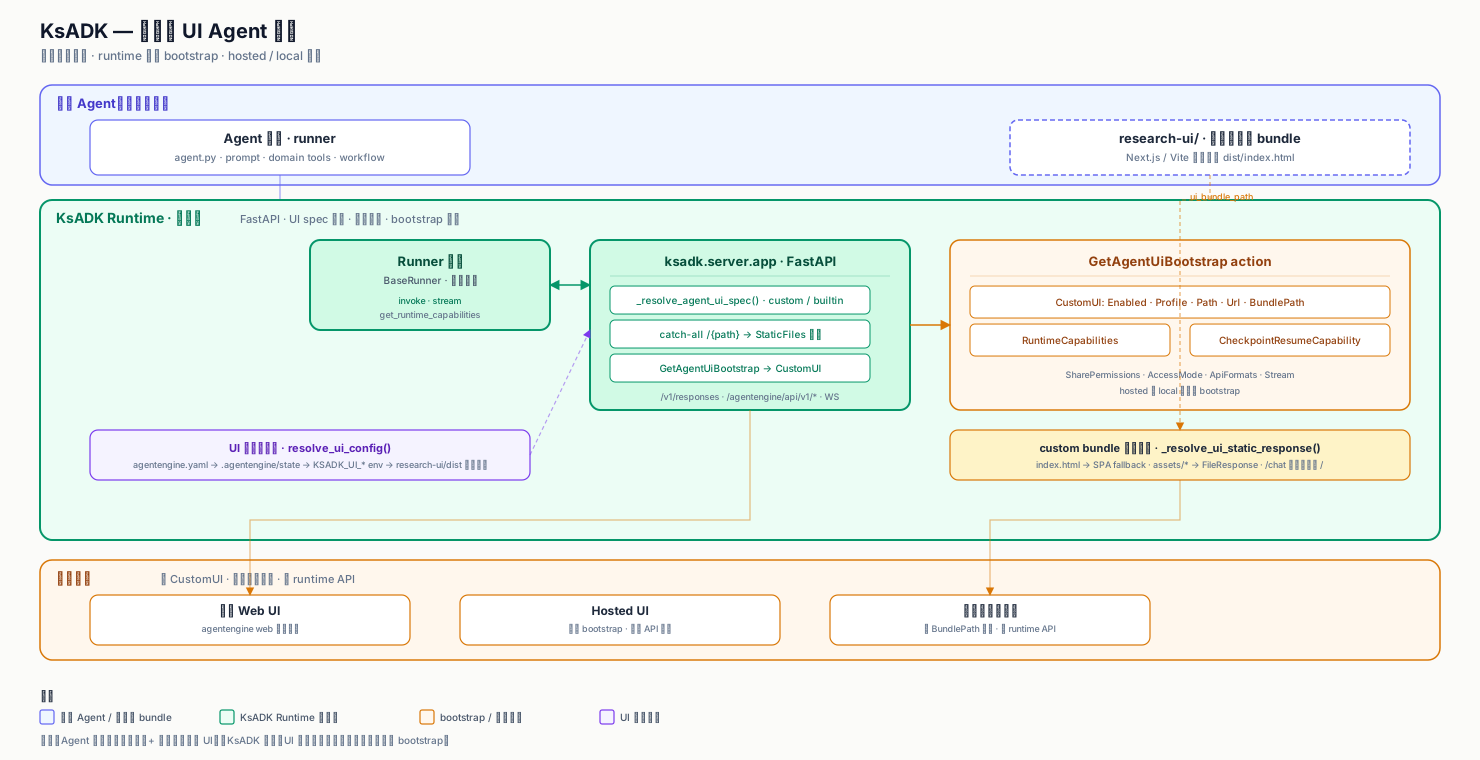
It is not "swap a skin". The core is that ksadk.server.app treats the UI as a resolvable spec (profile / path / url / bundle_path), replaces the StaticFiles mount point in FastAPI, and forwards that spec to the frontend via GetAgentUiBootstrap. The hosted UI and the local Web UI call the same action, so one bundle behaves identically in both.
What problem does it solve
Why not just let the business frontend run its own static server
The business frontend needs to call runtime APIs (/v1/responses, /agentengine/api/v1/*, WebSocket) and read runtime capabilities (checkpoint resume, attachments, workspace). Deploying the frontend separately creates three problems: CORS, capability discovery, and hardcoded paths. Mounting the bundle same-origin under the runtime, the bootstrap tells the frontend "who I am, what I can do, where the UI is" in one shot, and the frontend just renders.
Suitable scenarios:
- The agent's business frontend is not the ksadk built-in chat, but a custom UI with a research workbench, dashboard, or multi-step form.
- You want the same frontend bundle for local
agentengine weband hosted deployment, without maintaining two builds. - The frontend needs to consume bootstrap fields like
CustomUI/RuntimeCapabilities/CheckpointResumeCapabilityfor capability discovery.
Resolution chain: where the UI spec comes from
_resolve_agent_ui_spec() is the entry point. It merges four sources, by priority:
ui_profile/ui_path/ui_url/ui_bundle_pathinagentengine.yaml.- UI state persisted in
.agentengine/state(cached after the first local debug run). KSADK_UI_PROFILE/KSADK_UI_PATH/KSADK_UI_URL/KSADK_UI_BUNDLE_PATHenvironment variables (injected into serverless pods).- Auto-detection of
research-ui/dist/index.html— when nothing is declared explicitly and that file exists, the profile is auto-set to custom.
def _resolve_agent_ui_spec() -> dict[str, Any]:
    project_dir = _runner_project_dir()
    state = _ui_state_with_env_fallback(load_runtime_state(project_dir))
    framework = _current_framework()
    auto_custom_bundle_dir = _default_custom_ui_bundle_dir(project_dir)
    if (
        not state.get("ui_profile")
        and not state.get("ui_path")
        and not state.get("ui_url")
        and (auto_custom_bundle_dir / "index.html").exists()
    ):
        state["ui_profile"] = UI_PROFILE_CUSTOM
        state["ui_path"] = "/"
        state["ui_bundle_path"] = str(auto_custom_bundle_dir)
_ui_state_with_env_fallback layers environment variables on top of state, so a pod without .agentengine/ state still restores the UI config:
env_fallbacks = {
    "ui_profile": os.environ.get("KSADK_UI_PROFILE"),
    "ui_path": os.environ.get("KSADK_UI_PATH"),
    "ui_url": os.environ.get("KSADK_UI_URL"),
    "ui_bundle_path": os.environ.get("KSADK_UI_BUNDLE_PATH"),
}
Once the profile is set, resolve_ui_config() normalizes it: the custom profile defaults path to /, and /chat is auto-corrected back to / — the bundle does not need to patch the legacy chat path.
_DEFAULT_PATH_BY_PROFILE = {
    UI_PROFILE_ADK: "/chat",
    UI_PROFILE_LANGCHAIN: "/chat",
    UI_PROFILE_OPENCLAW: "/chat",
    UI_PROFILE_HERMES: "/chat",
    UI_PROFILE_CUSTOM: "/",
}

if profile == UI_PROFILE_CUSTOM and path == "/chat":
    path = "/"
ui_path must start with /
normalize_ui_path prepends / to any path without a leading slash. Under the custom profile, ui_path: research actually resolves to /research. Prefer writing / or /your-route directly to avoid confusing SPA routing.
Static routing: replacing the StaticFiles mount
Under the custom profile, the runtime does not use the built-in STATIC_DIR. Instead it points the catch-all route /{requested_path:path} at the bundle directory. _resolve_ui_static_response() resolves by bundle path:
- A request that lands on
ui_pathitself → returnsindex.html. - A request for
assets/*or with a file suffix → returns the matching static file, 404 only if missing. - Any other path (an SPA sub-route) → falls back to
index.htmlfor the frontend router to handle.
def _resolve_ui_static_response(request_path: str) -> Optional[FileResponse]:
    spec = _resolve_agent_ui_spec()
    if not spec.get("enabled"):
        return None

    bundle_dir = Path(str(spec["bundle_path"]))
    index_file = Path(str(spec["index_path"]))
    path = _normalize_request_ui_path(request_path)

    if spec.get("source") == "custom":
        ui_path = _normalize_request_ui_path(str(spec.get("path") or "/")).rstrip("/") or "/"
        if path == ui_path or path == f"{ui_path}/":
            return FileResponse(index_file)
        if ui_path != "/" and not path.startswith(f"{ui_path}/"):
            return None
        relative = path[len(ui_path):].lstrip("/") if ui_path != "/" else path.lstrip("/")
        if not relative:
            return FileResponse(index_file)
        candidate = bundle_dir / relative
        if candidate.exists() and candidate.is_file():
            return FileResponse(candidate)
        if not _is_custom_ui_static_asset_path(relative):
            return FileResponse(index_file)
        return None
enabled depends on index.html existing
In the spec, enabled = bundle_dir.exists() and index_file.exists(). If the bundle directory exists but index.html is missing, it is treated as disabled and the frontend falls back to the built-in UI or 404. Always confirm ui_bundle_path points to a directory that contains index.html in production.
GetAgentUiBootstrap: forwarding CustomUI
The frontend does not read agentengine.yaml directly. It calls GetAgentUiBootstrap to get a JSON description of the runtime. The custom UI fields live in the CustomUI block:
"CustomUI": {
    "Enabled": bool(ui_spec.get("enabled")),
    "Profile": ui_spec.get("ui_profile") or ui_spec.get("profile"),
    "Path": ui_spec.get("ui_path") or ui_spec.get("path"),
    "Url": ui_spec.get("ui_url") or ui_spec.get("url"),
    "BundlePath": ui_spec.get("ui_bundle_path") or ui_spec.get("bundle_path"),
},
The same action also carries Capabilities.RuntimeCapabilities, CheckpointResumeCapability, SharePermissions, ApiFormats, and Stream. The frontend uses these to decide whether to render a checkpoint-resume panel, enable streaming, or show attachment upload.
hosted and local share the same action
This is the key to "hosting": both the hosted UI and the local Web UI call /agentengine/api/v1/GetAgentUiBootstrap with the same field contract. Your bundle does not need to know "where am I running"; it just reads CustomUI and Capabilities.
Building a custom UI bundle
- Create the research-ui/ directory
The default detection path is research-ui/dist under the project root. So the frontend project lives in research-ui/ and its build output goes to research-ui/dist/.
my-agent/
├── agentengine.yaml
├── agent.py
└── research-ui/
    ├── package.json
└── (Next.js / Vite project)- Configure static export to dist
{
  "scripts": {
    "build": "vite build"
  }
}import { defineConfig } from "vite";
export default defineConfig({
build: {
outDir: "dist",
emptyOutDir: true,
},
});Vite outputs dist/index.html + dist/assets/* by default, which matches the custom bundle static-route detection.
/** @type {import('next').NextConfig} */
const nextConfig = {
  output: "export",
  distDir: "dist",
  trailingSlash: true,
};

module.exports = nextConfig;
output: "export" produces a static site, and distDir: "dist" puts the output on the runtime's default detection path.
- Wire up the runtime API
The bundle calls the following endpoints same-origin at runtime; no base URL configuration is needed:
POST /v1/responses— OpenAI-compatible Responses API, the main streaming chat entry.POST /agentengine/api/v1/RunAgent— AgentEngine native action, withStream/Background.POST /agentengine/api/v1/GetAgentUiBootstrap— fetch once on startup to readCustomUIandCapabilities.POST /agentengine/api/v1/CancelRun/ResumeRun— long-task cancel and resume.GET /agentengine/api/v1/SubscribeRunEvents— background task event subscription (SSE).
const res = await fetch("/agentengine/api/v1/GetAgentUiBootstrap", {
  method: "POST",
  headers: { "Content-Type": "application/json" },
  body: JSON.stringify({ AgentId: null, SessionId: null }),
});
const { Data } = await res.json();
const { CustomUI, Capabilities, SharePermissions } = Data;
WebSocket uses same-origin relative paths
If you use WebSocket (workspace file changes, terminal), the path looks like /agentengine/api/v1/ws/{agent_id}/{file_path}. When building the WebSocket URL in the frontend, use location.protocol to pick wss/ws and location.host for the host — never hardcode the host.
- Build and verify the output
cd research-ui
npm install
npm run build
ls dist/index.html
dist/index.html must exist for the custom bundle to be marked enabled.
Configure agentengine.yaml
Declare the custom profile explicitly to override auto-detection (recommended, to avoid depending on detection behavior):
name: my-custom-ui-agent
framework: adk
entry_point: agent.py
agent_variable: root_agent
ui_profile: custom
ui_path: /
ui_bundle_path: research-ui/dist
ui_bundle_path supports relative paths
_resolve_agent_ui_spec resolves relative paths against project_dir. Writing research-ui/dist is enough — no absolute path needed. Absolute paths are used as-is without project_dir joining.
Do not set ui_path to /chat under custom
resolve_ui_config corrects /chat to / under the custom profile. If you really want a sub-route (e.g. /research), set ui_path: /research and make sure your SPA router handles that prefix.
Local debugging
agentengine web converts the agentengine.yaml UI config into environment variables via _configure_custom_ui_env() before starting the runtime — so local and serverless pods use the same env-fallback chain:
def _configure_custom_ui_env(agent_path: Path) -> str:
    config = _load_agentengine_config(agent_path)
    if str(config.get("ui_profile") or "").strip().lower() != "custom":
        return "/"

    bundle_path = str(config.get("ui_bundle_path") or "").strip()
    bundle_dir = agent_path / bundle_path
    if not (bundle_dir / "index.html").is_file():
        return "/"

    ui_path = _normalize_ui_path(str(config.get("ui_path") or "/"))
    os.environ["KSADK_UI_PROFILE"] = "custom"
    os.environ["KSADK_UI_PATH"] = ui_path
    os.environ["KSADK_UI_BUNDLE_PATH"] = bundle_path
    return ui_path
Even without an agentengine.yaml, as long as research-ui/dist/index.html exists, the runtime auto-detects and enables the custom bundle.
cd my-agent
agentengine web .
Conditions for local auto-detection
Auto-detection requires that ui_profile, ui_path, and ui_url are all undeclared, and research-ui/dist/index.html exists. Once you set ui_profile: custom in agentengine.yaml, the declaration wins and detection is skipped.
Deploy to hosted
The serverless deployment injects the resolved UI config into the pod env via _inject_ui_runtime_env() — it does not package the local .agentengine/ state:
if profile:
    env_vars["KSADK_UI_PROFILE"] = str(profile)
if path:
    env_vars["KSADK_UI_PATH"] = str(path)
if url:
    env_vars["KSADK_UI_URL"] = str(url)
if bundle_path:
    env_vars["KSADK_UI_BUNDLE_PATH"] = str(bundle_path)
The serverless provider reads ui_bundle_path from agentengine.yaml, builds research-ui/dist into the image, and injects the four KSADK_UI_* environment variables at runtime. Inside the pod, ksadk.server.app restores the config via _ui_state_with_env_fallback.
agentengine build .
agentengine deploy --provider serverless
Confirm the bundle is in the image: dist/index.html must be packaged with the image, otherwise enabled=false.
The Hermes runtime runs a TUI and does not consume the custom bundle static route. If your agent also needs a hosted UI, hand the build output to a separate frontend project and set ui_url in agentengine.yaml to point at it — CustomUI.Url is forwarded to the hosted UI for redirection.
OpenClaw is a TUI framework like Hermes (_NATIVE_TUI_FRAMEWORKS); the custom bundle static route does not apply. To attach a custom frontend, use ui_url to declare an external frontend URL, same as Hermes.
Hermes / OpenClaw do not mount the custom bundle static route
The custom branch of _resolve_agent_ui_spec only triggers when the profile resolves to custom. Hermes / OpenClaw resolve to the hermes / openclaw profile and use the built-in STATIC_DIR. To attach a custom frontend to these runtimes, use ui_url, not ui_bundle_path.
Verify
After deployment, call GetAgentUiBootstrap and confirm the CustomUI block matches expectations:
curl -s -X POST https://<your-runtime>/agentengine/api/v1/GetAgentUiBootstrap \
  -H "Content-Type: application/json" \
  -d '{"AgentId": null, "SessionId": null}' | jq '.Data.CustomUI'
Expected output (serverless):
{
  "Enabled": true,
  "Profile": "custom",
  "Path": "/",
  "Url": null,
  "BundlePath": "/app/research-ui/dist"
}
Enabled: true means the bundle directory and index.html both exist; BundlePath is the absolute path inside the pod. If Enabled: false, check whether the directory pointed to by KSADK_UI_BUNDLE_PATH exists in the image and whether index.html was packaged with the build output.
Project structure
Further reading
Local Web UI
Custom bundle auto-detection, streaming fixes, and common-failure troubleshooting.
Build and package
How the serverless image build packages research-ui/dist into the artifact, and UI config env injection details.
Long-task resume and Deep Research continuation
How a custom research workbench consumes CheckpointResumeCapability to render a resume panel.
ksadk-samples repo
Full runnable demo source including a research-ui/ workbench.